Greatest Common Divisor (GCD)
 |
Greatest Common Divisor (GCD) |
|
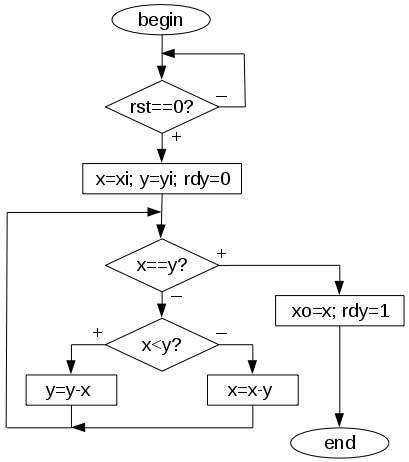
  while ( x != y ) {
    if ( x < y ) y = y - x;
    else x = x - y;
  }
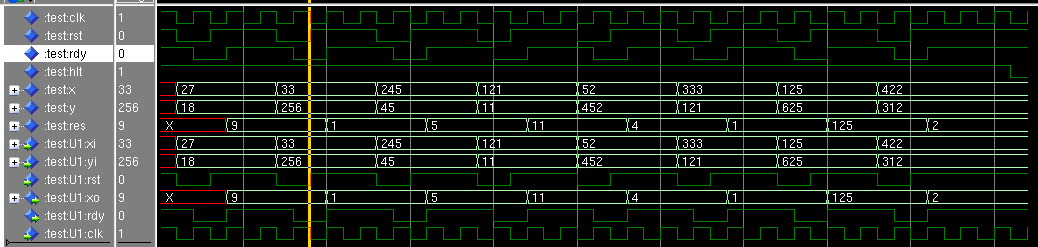
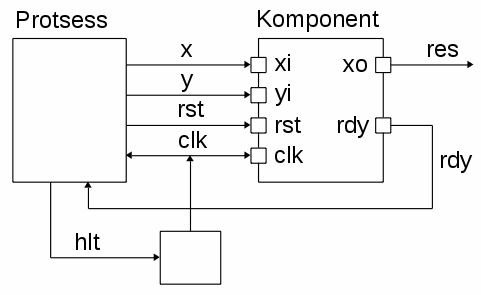
Input (x, y) and output signals (xo), and control signals (rst - reset, rdy - ready). The I/O protocol is based on the following - when rst=='0', inputs are latched into internal registers and rdy<='0' indicates that the algorithm has started. The test bench sets rst back to '1' and waits until rdy gets '1' - the algorithm has finished and the result is on the output. Of course, the polarity if control signals can be changed but the the test bench must be modified accordingly.
| Control Data Flow Graph | VHDL | SystemVerilog |
 |
library IEEE;
use IEEE.std_logic_1164.all;
use IEEE.std_logic_arith.all;

entity gcd is
  port (xi, yi : in unsigned(15 downto 0);
        rst    : in bit;
        xo     : out unsigned(15 downto 0);
        rdy    : out bit := '1';
        clk    : in bit);
end gcd;

library IEEE;
use IEEE.std_logic_1164.all;
use IEEE.std_logic_arith.all;

architecture experiments of gcd is
begin

  process
    variable x, y: unsigned(15 downto 0);
  begin
    -- Wait for the new input data
    wait on clk until clk='1' and rst='0';

    x := xi;    y := yi;    rdy <= '0';
    wait on clk until clk='1';

    -- Calculate
    while  x /= y  loop
      if  x < y  then y := y - x;
      else            x := x - y;    end if;
    end loop;

    -- Ready
    xo <= x;    rdy <= '1';
    wait on clk until clk='1';
  end process;

end experiments; |
`timescale 1 ns / 1 ns

module gcd (
  input logic unsigned [15:0] xi, yi,
  input logic rst,
  output logic unsigned [15:0] xo,
  output logic rdy,
  input logic clk );

  logic unsigned [15:0] x, y;

  initial rdy = 1;

  always begin
    // Wait for the new input data
    while ( rst == 1 ) @(posedge clk);

    x = xi;    y = yi;    rdy = 0;
    @(posedge clk);

    // Calculate
    while ( x != y )
      if ( x < y )  y = y - x;
      else          x = x - y;

    // Ready
    xo = x;    rdy = 1;
    @(posedge clk);
  end

endmodule
|
Simulation results of the behavioral model (the test bench is below):
| Test bench | VHDL | SystemVerilog |
 |
library IEEE;
use IEEE.std_logic_1164.all;
use IEEE.std_logic_arith.all;

entity test is    end test;

architecture bench of test is
  signal clk, rst, rdy, hlt: bit := '1';
  signal x, y, res: unsigned(15 downto 0);

  component gcd
    port (xi, yi : in unsigned(15 downto 0);
          rst    : in bit;
          xo     : out unsigned(15 downto 0);
          rdy    : out bit;
          clk    : in bit);
  end component;
begin
  clk <= not clk after 10 ns when hlt='1';

  U1: gcd port map (x, y, rst, res, rdy, clk);

  process
    type int_array is array (0 to 7) of integer;
    constant a: int_array := (27, 33, 245, 121, 52, 333, 125, 422);
    constant b: int_array := (18, 256, 45, 11, 452, 121, 625, 312);
    -- expected results (GCD)  9,  1,  5,  11,  4,   1,  125,   2
  begin
    wait on clk until clk='0';
    for  i in a'range  loop
      x <= conv_unsigned(a(i),16);
      y <= conv_unsigned(b(i),16);
      rst <= '0';
      wait on clk until clk='0';
      rst <= '1';
      --wait on clk until clk='0';
      while  rdy = '0'  loop
        wait on clk until clk='0';
      end loop;
      wait on clk until clk='0';
    end loop;
    wait on clk until clk='0';
    hlt <= '0';    wait;
  end process;
end bench; |
`timescale 1 ns / 1 ns

module  testbench;
  logic clk, rst, rdy;
  logic unsigned [15:0] x, y, res;

  // expected results (GCD)
  //   9,   1,   5,  11,   4,   1, 125,   2
  parameter logic unsigned [15:0] a [8] =
    { 27,  33, 245, 121,  52, 333, 125, 422 };
  parameter logic unsigned [15:0] b [8] =
    { 18, 256,  45,  11, 452, 121, 625, 312 };

  initial clk = 1;  always #10 clk = !clk;

  gcd u1 (x, y, rst, res, rdy, clk);

  initial begin
    rst = 1;
    @(negedge clk);
    for ( int i=0; i<8; i++ ) begin
      x = a[i];  y = b[i];  rst = 0;
      @(negedge clk)  rst = 1;
      // @(negedge clk);
      while ( rdy == 0 )  @(negedge clk);
      @(negedge clk);
    end
    @(negedge clk) $stop;
  end

endmodule
|
| Clocked behavioral model | VHDL | SystemVerilog |
 |
library IEEE;
use IEEE.std_logic_1164.all;
use IEEE.std_logic_arith.all;

architecture experiments of gcd is
  signal x, y: unsigned(15 downto 0);
begin

  process begin
    -- Wait for the new input data
    while  rst = '1'  loop
      wait on clk until clk='1';
    end loop;

    x <= xi;    y <= yi;    rdy <= '0';
    wait on clk until clk='1';

    -- Calculate
    while  x /= y  loop
      if  x < y  then y <= y - x;
      else            x <= x - y;    end if;
      wait on clk until clk='1';
    end loop;

    -- Ready
    xo <= x;    rdy <= '1';
    wait on clk until clk='1';
  end process;

end experiments; |
`timescale 1 ns / 1 ns

module gcd (
  input logic unsigned [15:0] xi, yi,
  input logic rst,
  output logic unsigned [15:0] xo,
  output logic rdy,
  input logic clk );

  logic unsigned [15:0] x, y;

  always begin
    // Wait for the new input data
    while ( rst == 1 ) @(posedge clk);

    x = xi;    y = yi;    rdy = 0;
    @(posedge clk);

    // Calculate
    while ( x != y ) begin
      if ( x < y )  y = y - x;
      else          x = x - y;
      @(posedge clk);
    end

    // Ready
    xo = x;    rdy = 1;
    @(posedge clk);
  end

endmodule
|
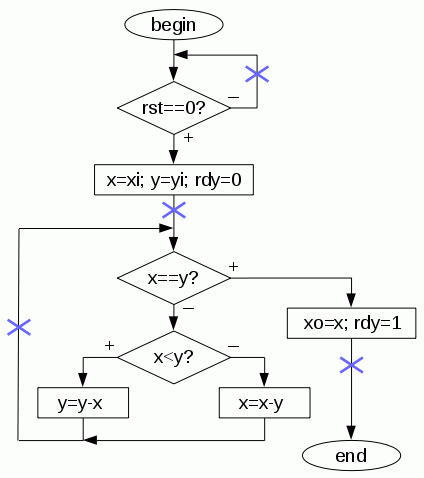
Simulation results of the clocked behavioral model:

| Behavioral state machine | VHDL | SystemVerilog |
 |
library IEEE;
use IEEE.std_logic_1164.all;
use IEEE.std_logic_arith.all;

architecture experiments of gcd is
  type state_type is (S_wait, S_start, S_ready);
  signal state: state_type;
  signal x, y: unsigned(15 downto 0);
begin

  process begin
    wait on clk until clk='1';
    case state  is
    -- Wait for the new input data
    when S_wait =>
      if  rst='0'  then
        x <= xi;    y <= yi;    rdy <= '0';    state <= S_start;
      end if;
    -- Calculate
    when S_start =>
      if  x /= y  then
        if  x < y  then    y <= y - x;
        else               x <= x - y;    end if;
        state <= S_start;
      else
        xo <= x;    rdy <= '1';    state <= S_ready;
      end if;
    -- Ready
    when S_ready =>    state <= S_wait;
    end case;
  end process;

end experiments; |
`timescale 1 ns / 1 ns

module gcd (
  input logic unsigned [15:0] xi, yi,
  input logic rst,
  output logic unsigned [15:0] xo,
  output logic rdy,
  input logic clk );

  // State - type & signals
  // Will be interpreted as 32-bit integer in syhtesis and 'default'
  // must be used in case statements to avoid latches. Synthesizer
  // will remove extra 30 bits.
  enum {S_wait, S_start, S_comp, S_ready} state, next_state;

  logic unsigned [15:0] x, y;

  always @(posedge clk)
    case (state)
      // Wait for the new input data
      S_wait :
        if (rst==0) begin
          x <= xi;    y <= yi;    rdy <= 0;    state <= S_start;
        end
      // Calculate
      S_start :
        if ( x != y ) begin
          if ( x < y )  y <= y - x;
          else          x <= x - y;
          state <= S_start;
        end
        else begin
          xo <= x;    rdy <= 1;    state <= S_ready;
        end
      // Ready
      default : state <= S_wait;
    endcase

endmodule
|
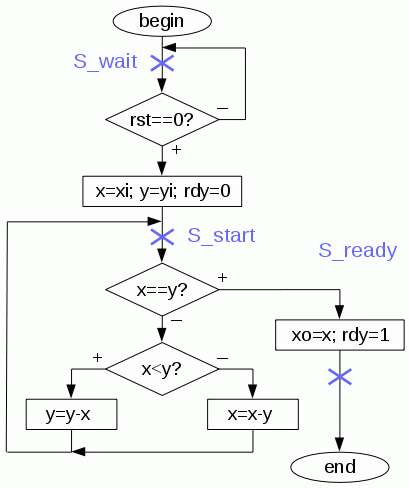
Simulation results of the behavioral state machine model:

Beginning of the same simulation - changing of states is visible:

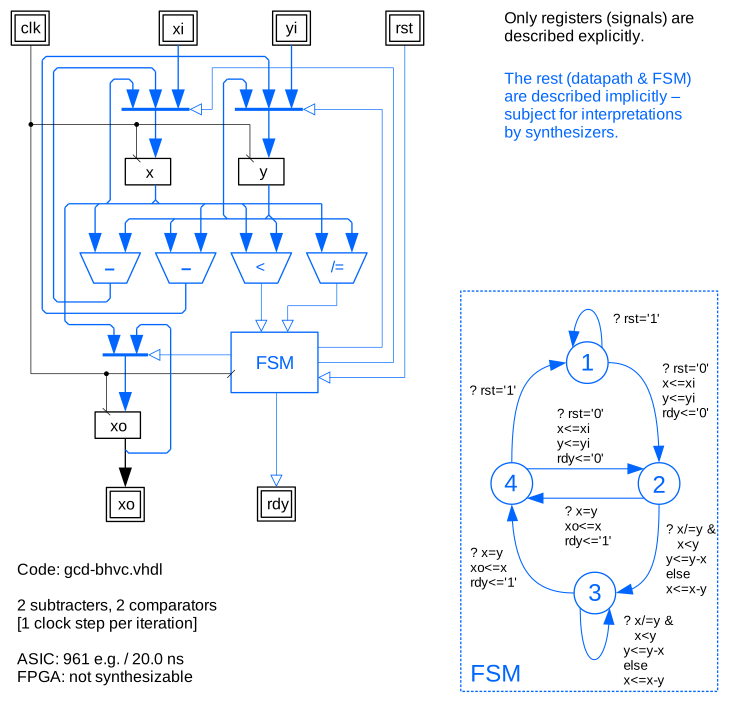
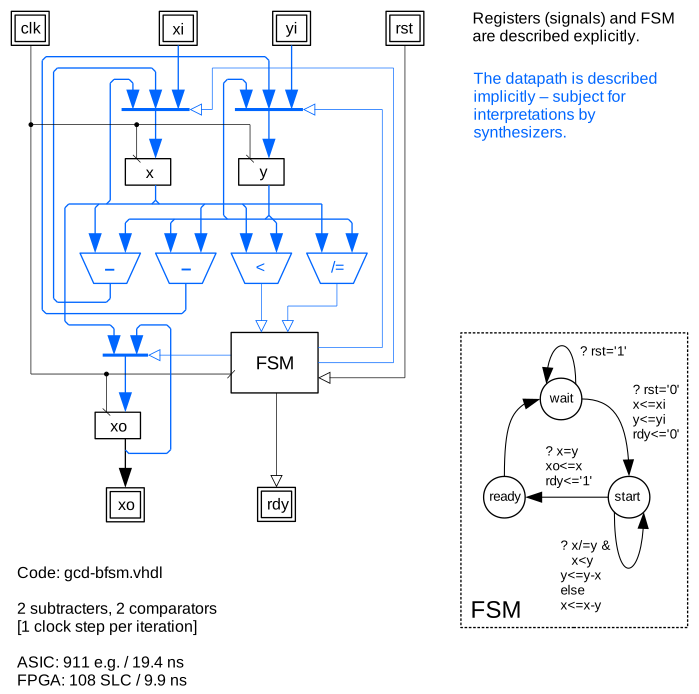
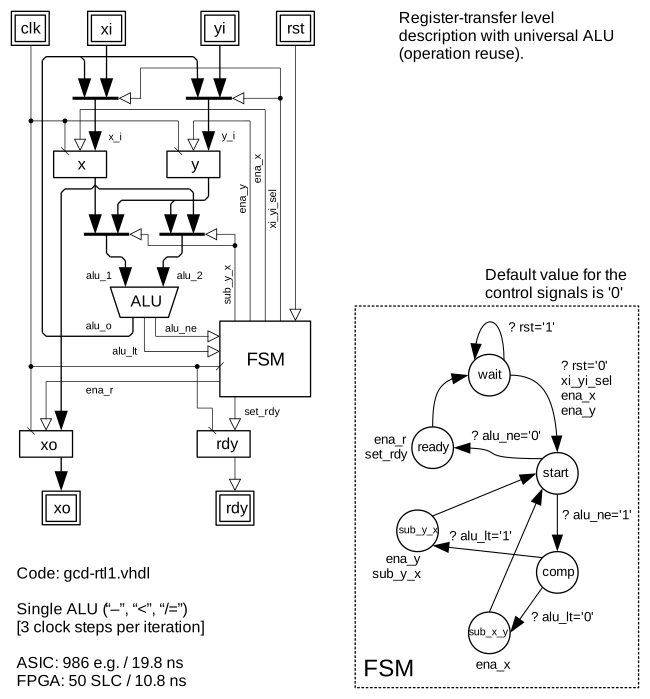
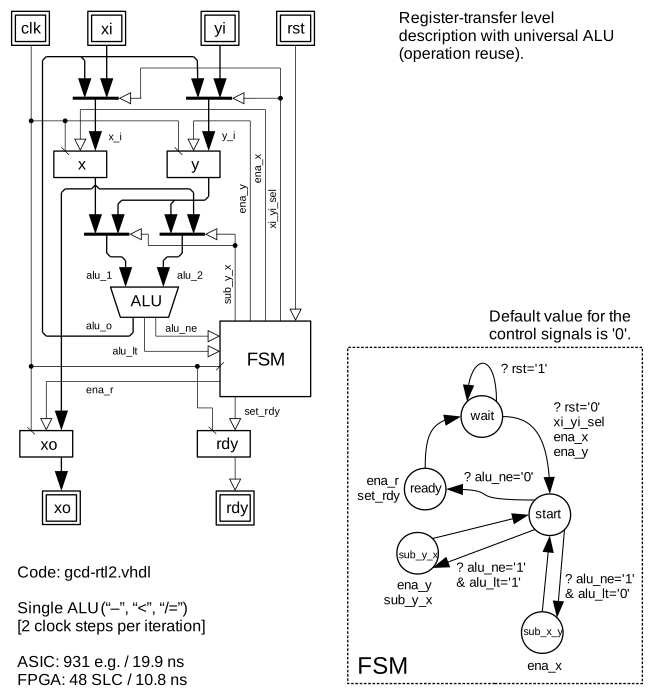
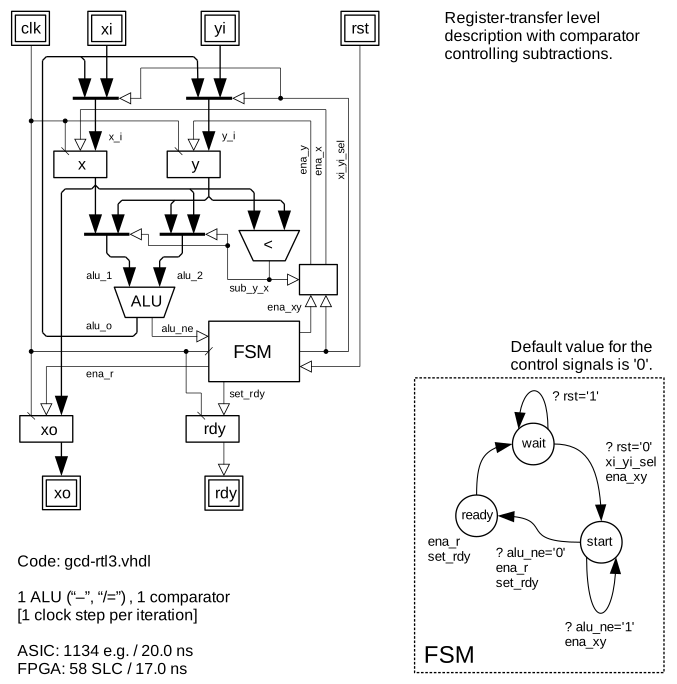
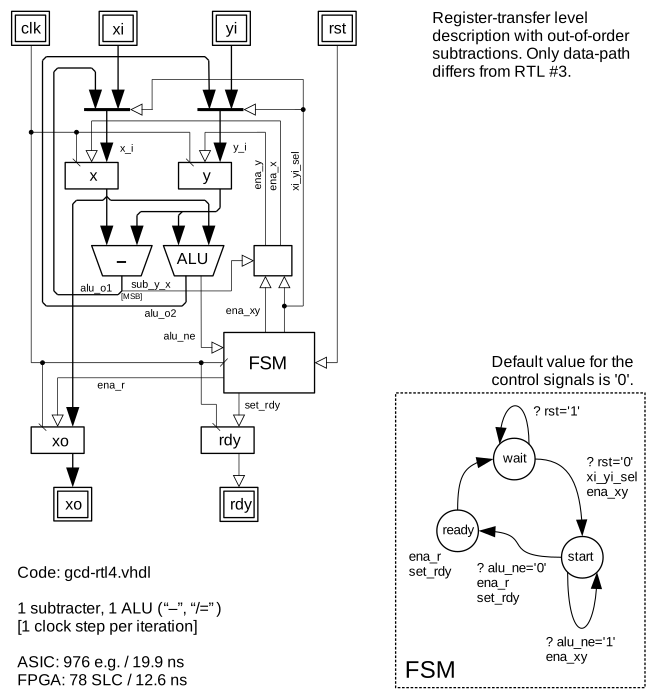
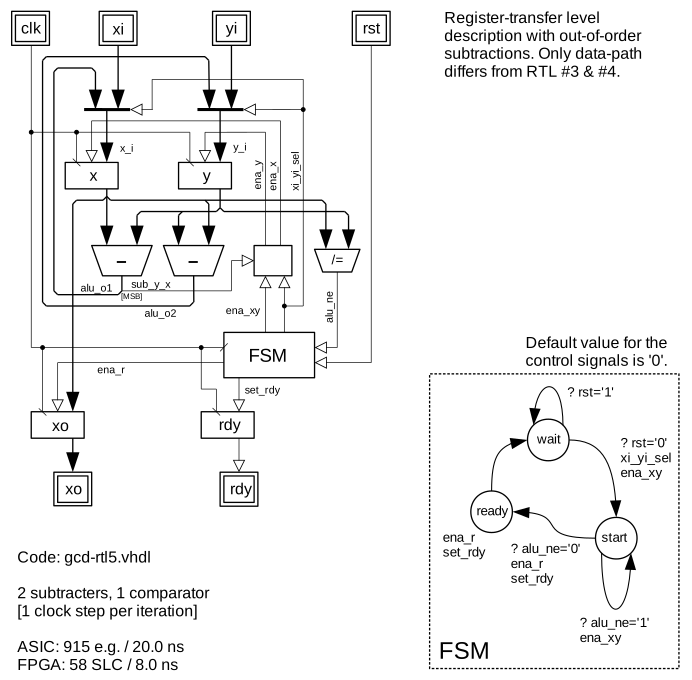
The next five models fully match the register-transfer level (RTL) abstractions - there is a clear state machine and the data-part consists of components (register, multiplexers, subtracters, etc). Also, internal control signals exist. All models are synthesizable.
RTL #1 (VHDL/SystemVerilog) - single ALU, 3 clock cycles per iteration (see structure).
RTL #2 (VHDL/SystemVerilog) - single ALU, 2 clock cycles per iteration (see structure).
RTL #3 (VHDL/SystemVerilog) - comparator (less than) controls subtraction, 1 clock cycle per iteration – small but slow (sequential) data-part (see structure).
RTL #4 (VHDL/SystemVerilog) and RTL #5 (VHDL/SystemVerilog) - out-of-order execution – both subtractions are calculated first then the decision is made. The difference is how deciders/comparators are implemented (see structure #4 and structure #5).
Synthesis results and RTL schematics (VHDL/SystemVerilog).
Hand-outs about the algorithm description and different implementations (VHDL).
HDL files to compare components - subtracter and two comparators (VHDL/SystemVerilog), universal ALU (VHDL/SystemVerilog), and test bench for checking (VHDL/SystemVerilog).